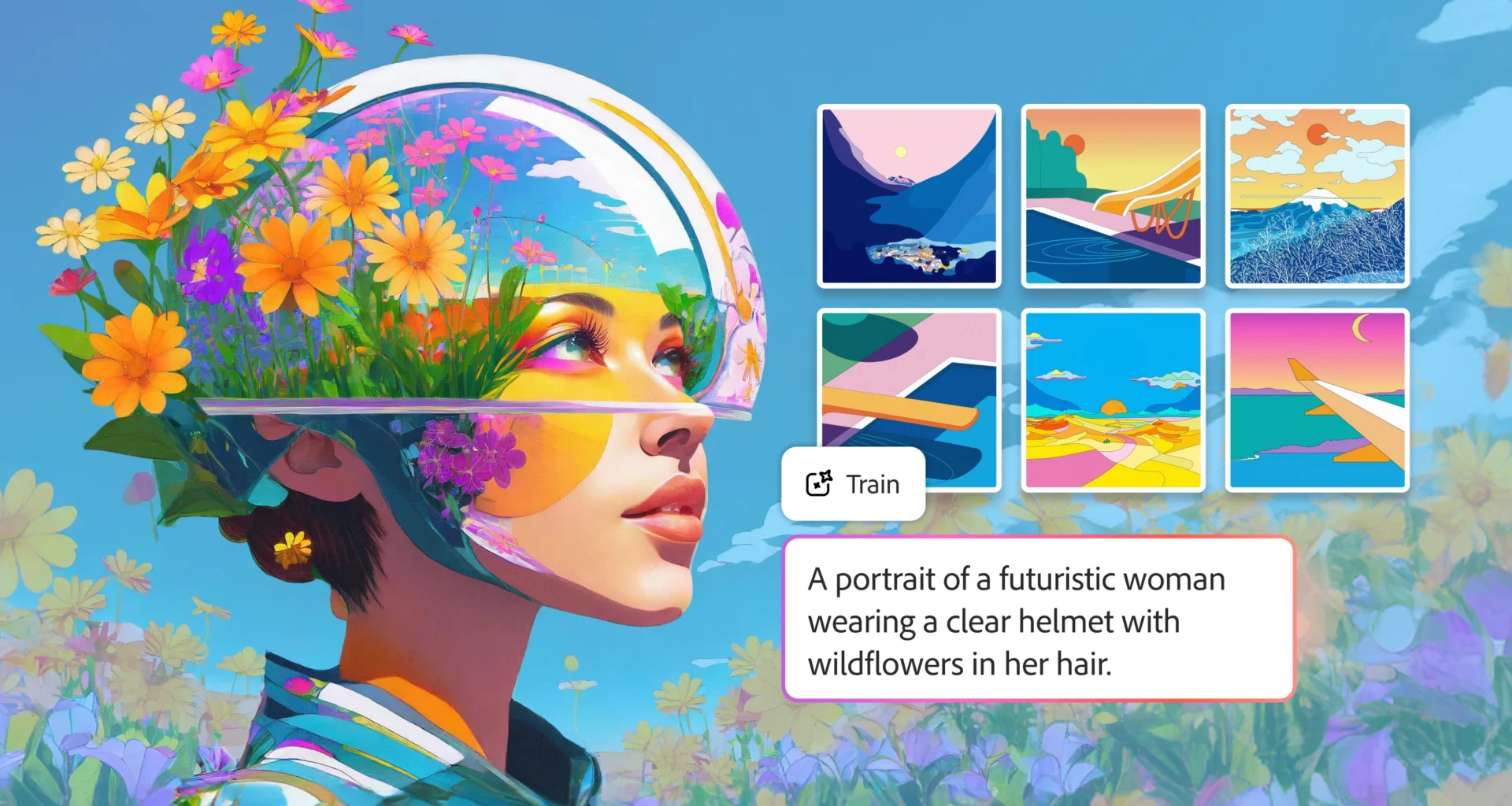
Adobe recently expanded access to Firefly Custom Models, moving the feature into public beta and giving creators a new way to generate AI-powered content tailored to a specific visual identity. The technology allows users to train models using their own imagery, making it easier to produce artwork that aligns with established brand guidelines, recurring characters, illustration styles, color systems, and other creative assets.
For many designers, this could represent a significant step forward for generative AI. One of the technology’s biggest frustrations has been its tendency to produce inconsistent results, forcing creators to spend countless hours refining prompts and correcting details. Custom models aim to solve that problem by helping AI understand and reproduce a creator’s unique aesthetic more reliably.
To learn more about the initiative and Adobe’s broader AI strategy, we spoke with Deepa Subramaniam, Vice President of Product Marketing for Creative Professionals at Adobe.
Why should creatives be excited about Firefly Custom Models?
According to Subramaniam, consistency has long been one of the most difficult challenges in generative AI.
“Your style is yours, and yours alone,” she explained. “But until now, maintaining that style across AI-generated outputs has been difficult and time-intensive for creative professionals and their teams.”
Now available through a broad public beta, Firefly Custom Models allow users to transform their artistic approach into a reusable AI model trained on their own visual content. The system is optimized for creative exploration across illustration, character design, and photography, enabling creators to generate ideas while preserving the distinctive qualities that define their work.
Subramaniam described the result as a creative partner capable of accelerating experimentation without stripping away individuality.
Importantly, Adobe says the models remain private by default, ensuring that both the custom-trained systems and the content they generate remain under the creator’s control.
Users can also combine their custom models with more than 30 AI models available through Firefly, including offerings from Google, Runway, and Adobe itself. Those generations can then be refined using Firefly’s expanding suite of editing tools, such as Quick Cut, which transforms raw footage into a structured video edit, and enhanced image-editing capabilities designed to move projects from concept to production-ready assets in a fraction of the usual time.
How are custom models changing creative workflows?
Subramaniam explained that Adobe originally introduced the technology to enterprise customers, where large teams often face intense pressure to produce substantial amounts of content while maintaining strict brand consistency.
That early deployment provided valuable insight into how creative organizations operate, what obstacles they encounter, and how AI tools can be integrated into existing workflows without disrupting established processes.
The timing appears significant. Adobe’s research indicates that generative AI has rapidly become a core component of modern creative work. According to the company’s Creators’ Toolkit Report, 86% of creators already use generative AI tools, while 76% say those tools have contributed to the growth of their businesses or personal brands.
As adoption increases, however, the challenge shifts from simply generating content to scaling production while preserving quality and consistency.
Custom models address that challenge by capturing key stylistic elements—such as lighting preferences, color palettes, visual treatments, and line work—from the outset. Instead of manually adjusting these details across every asset, creators can focus their energy on broader creative decisions, storytelling, and artistic direction.
For some organizations, the impact has already been substantial.
Amazon Fresh reportedly reduced production turnaround times by 93% across hundreds of images. Newell Brands has accelerated campaign creation by a factor of five while maintaining strict brand standards, and IPG Health developed an entirely new brand identity in just 10 days. Other companies are using custom models to compress ideation timelines from weeks into days or generate thousands of personalized assets at scale.
Subramaniam believes the key benefit lies in providing creators with a reliable starting point that enables faster execution without forcing them to begin every project from scratch.
Which industries stand to benefit the most?
According to Adobe, sectors that depend heavily on marketing and content creation have seen some of the strongest results so far.
Industries such as retail, consumer goods, financial services, healthcare, and education frequently need to produce large volumes of creative material while maintaining visual consistency across multiple markets, campaigns, and channels.
What unites these organizations is a common challenge: creating more content, more variations, and more personalized experiences without diluting brand identity.
Custom models help address this issue by embedding visual standards directly into the AI workflow, allowing teams to generate and adapt assets more efficiently while remaining aligned with established branding.
A similar trend is emerging in entertainment and media through Adobe’s Firefly Foundry initiative. Studios and intellectual property owners are training models using proprietary content to expand fictional universes, accelerate production processes, and extend storytelling across multiple formats.
Whether the user is a global brand or an independent artist, the objective remains the same: increase creative output without sacrificing originality.
How does Adobe see conversational AI shaping creative workflows?
Adobe’s vision extends beyond image generation.
Subramaniam believes conversational interfaces are becoming an increasingly natural way for creators to interact with software, allowing them to describe ideas in plain language and have AI assist in bringing those concepts to life.
This philosophy underpins Project Moonlight, Adobe’s initiative focused on integrating conversational AI directly into creative applications.
Rather than functioning as a standalone chatbot, Moonlight is intended to become part of the tools creatives already use every day. The goal is not to replace traditional hands-on creation but to complement it.
Users might begin by describing a concept, exploring ideas, learning techniques, or automating repetitive tasks through conversation. From there, they can transition seamlessly into detailed editing and refinement using familiar creative controls.
Subramaniam sees this combination of natural language interaction and precise craftsmanship as the future of AI-assisted creativity.
Over time, Adobe expects these assistants to become increasingly context-aware, capable of understanding a creator’s preferences, assets, objectives, and ongoing projects. Rather than assisting with isolated tasks, they could help coordinate work across multiple applications, carrying context from brainstorming through final production.
In this vision, conversational AI becomes less of a tool and more of a collaborative partner that supports creators throughout the entire process while minimizing interruptions and preserving creative momentum.
Ultimately, Adobe’s objective is to make sophisticated workflows feel more intuitive, allowing creators to devote more attention to vision, strategy, and artistic direction while AI handles supporting tasks behind the scenes.
That strategy aligns with Adobe’s broader effort to embed conversational AI wherever creative work happens. Beyond its own applications—including Acrobat, Adobe Express, Photoshop, and other Creative Cloud products—the company is also extending support to third-party platforms such as ChatGPT, Microsoft 365 Copilot, and additional AI-powered environments, ensuring that creators can access Adobe’s capabilities without leaving the tools they already rely on.